Why signal validity matters
In fast-moving markets, not every alert deserves your attention. A valid crypto futures signal is one that clears a threshold of reliability—strong enough to justify committing capital, but also transparent enough that traders understand why it was issued. Without validity, signals risk becoming noise. The difference between noise and structure can make or break trading consistency.
Core ingredients of a valid signal
Every AI-driven crypto signal rests on a mix of quantitative and time-based inputs. Professional providers publish how they weigh and refine these. Here are the essential components:
- Trend filters – Signals must align with the dominant market direction. Strong moving averages, EMA clusters, or momentum oscillators filter out counter-trend noise.
- Order flow checks – Depth of book, bid/ask pressure, and sudden liquidity shifts confirm whether the signal has real participation behind it.
- Volatility bands – Bollinger, ATR, or custom bands ensure that the move is large enough to clear expected fee drag and not just micro-fluctuations.
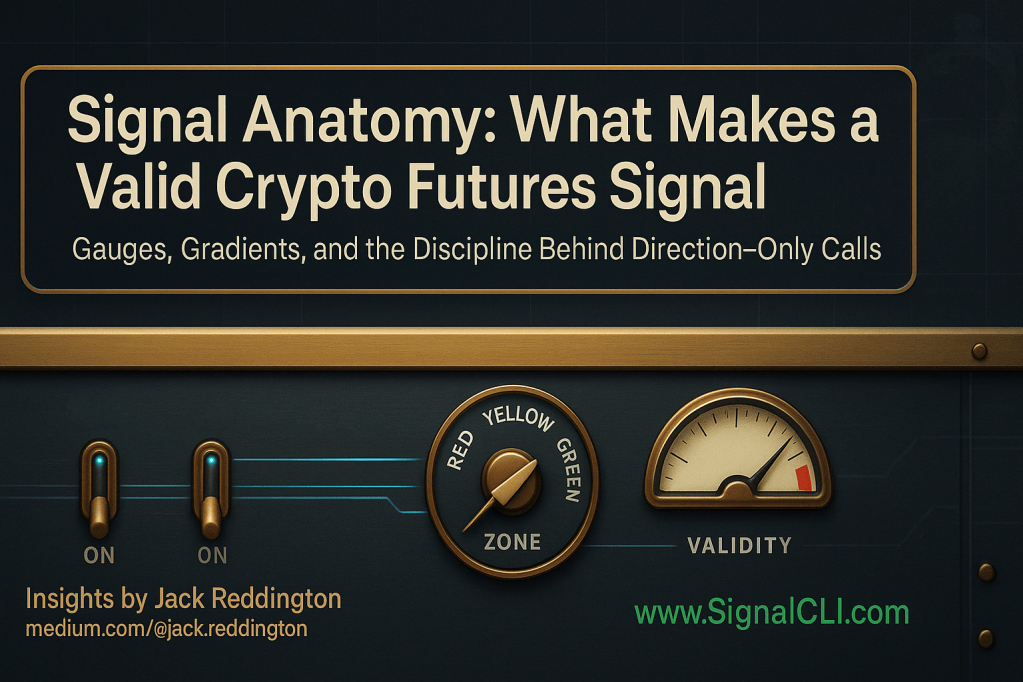
- Time-based triggers – A valid daily schedule anchors signals to specific windows. Within these, Zone grading and Gradients mark quality tiers: Green Zones (cleaner, higher win rate), Yellow Zones (caution), Red Zones (avoid).
- Historical validation – Backtests and rolling hit rates confirm that today’s signals behave in line with historical norms.
A valid signal doesn’t just say “up or down.” It says “direction, in context, at this time, with this level of quality.”
What signals deliberately exclude
Equally important is what a valid signal leaves out. Professional systems don’t chase price targets or promise ROI. They deliver direction-only signals so traders can act quickly across different exchanges. Price levels vary by venue, but direction tends to rhyme. This keeps the signal focused on what machines do best: rapid detection of setups.
Human judgment still matters
Even the best crypto futures signals don’t replace human oversight. Traders still decide how much to size, whether news or policy events override a setup, and how to manage risk. Context—trend health, macro announcements, roadmap milestones—remains outside the scope of automation. Valid signals handle detection; humans supply judgment.
Why transparency is essential
Signals become infrastructure when they are auditable. Providers that share performance dashboards, sample trades, and methodology notes give users confidence that alerts aren’t cherry-picked. Transparency is part of validity. Without it, businesses and traders can’t build repeatable strategies around signals.
Lessons from invalid signals
Invalid signals are often easy to spot: no clear logic, inconsistent delivery times, and no grading system. They may flood users with alerts, or worse, show only screenshots of winners without logging losses. These create noise, inflate costs, and damage discipline. Traders who rely on them often overtrade and face higher fees with no added edge.
Building a framework for trust
For a signal to be valid, three questions must be answered:
- Does it align with measurable market structure?
- Is it delivered within a published schedule with clear Zone grading?
- Can its performance be independently reviewed?
If the answer is yes to all three, traders can integrate the signal into a disciplined routine with confidence.
Key takeaways
- Valid crypto futures signals combine trend filters, order flow, volatility checks, and time-based windows.
- Daily schedules, Zone grading, and Gradients add structure so traders know when quality is highest.
- Direction-only signals keep things simple and exchange-agnostic.
- Human judgment still matters for news, risk, and sizing.
- Transparency and auditability are non-negotiable.
Relevance?
As adoption grows, crypto signals are shifting from optional add-ons to professional infrastructure. Validity isn’t just a technical detail—it’s what allows traders to trust automation without giving up control. Teams that adopt valid, transparent signal systems gain consistency. Those that rely on noise risk higher fees, lower confidence, and weaker results.
About SignalCLI
SignalCLI is a crypto futures signals provider focused on clarity, precision, and informed decision-making. Using a combination of established technical indicators, Smart Money Concepts, and advanced AI analysis, SignalCLI delivers structured, data-driven insights to help traders identify high-probability setups in fast-moving markets. The service is designed for those who value disciplined execution, risk awareness, and timing over speculation. For deeper insights and practical examples, visit www.signalcli.com and explore Jack Reddington’s Medium for trading strategies, market breakdowns, and educational articles.


 Cryptonic Tech Blog
Leave a comment